
From 0 to 812 customers — then finding the retention gap
Premium Italian restaurant, Jeddah
The restaurant's POS had zero registered customers — not because seats were empty, but because no one captured customer data at the point of sale. Every guest left invisible: no name, no number, no way to reach them again, and no foundation for loyalty or re-targeting.
Start by registering every customer at the POS from day one, let the data accumulate, then analyse it to see whether guests actually return — and translate any gap into a SAR figure the owner could act on.
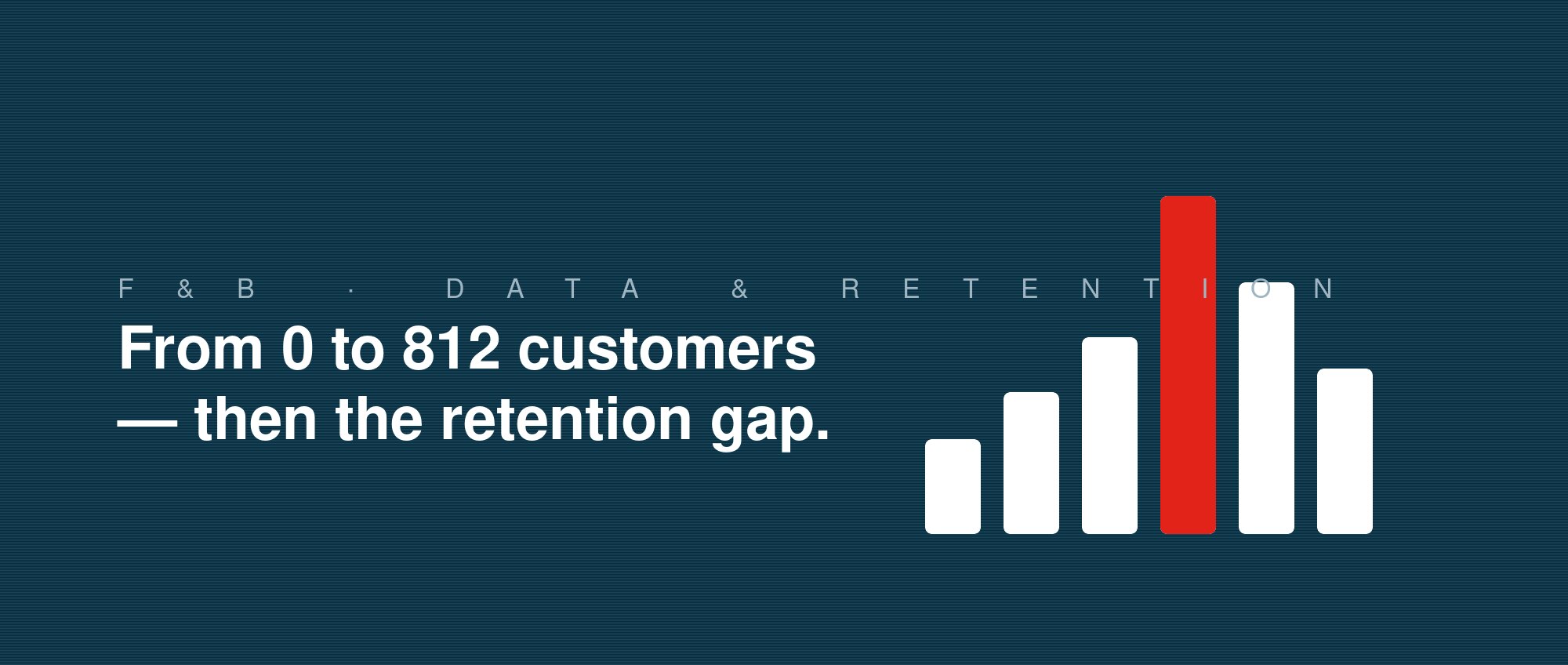
Over roughly two months (Feb 12 – Apr 14, 2026, ~61 days), the restaurant went from zero to 812 registered customers, with an Eid-week spike of 238 sign-ups. The retention analysis was blunt: only 66 customers returned for a second order — an 8.1% retention rate against a 25–40% industry benchmark.
Zero to 812 in two months proved the restaurant could fill seats; the data then showed the next lever was retention. With 746 one-time guests still reachable, a 25% retention scenario modelled a recoverable SAR ~50,700 opportunity from the same customer base — no extra acquisition spend. A loyalty and win-back plan is now in progress.
Weekly new customers (Feb 12 – Apr 14, 2026)
Eid week (Mar 19) drove the spike. Illustrative weekly split — totals to 812. Replace with exact Foodics export before publishing.
Supporting data
On the ground: making an invisible storefront impossible to miss
The data work wasn't the only intervention. In the multi-brand complex the restaurant sits in, every neighbouring storefront announced itself — but this unit was effectively invisible, and guests walked past as if it were empty. In a market this crowded that's existential: after outlets nearly doubled post-2021, around 30% of Saudi F&B establishments now close within their first three years (Mukatafa).
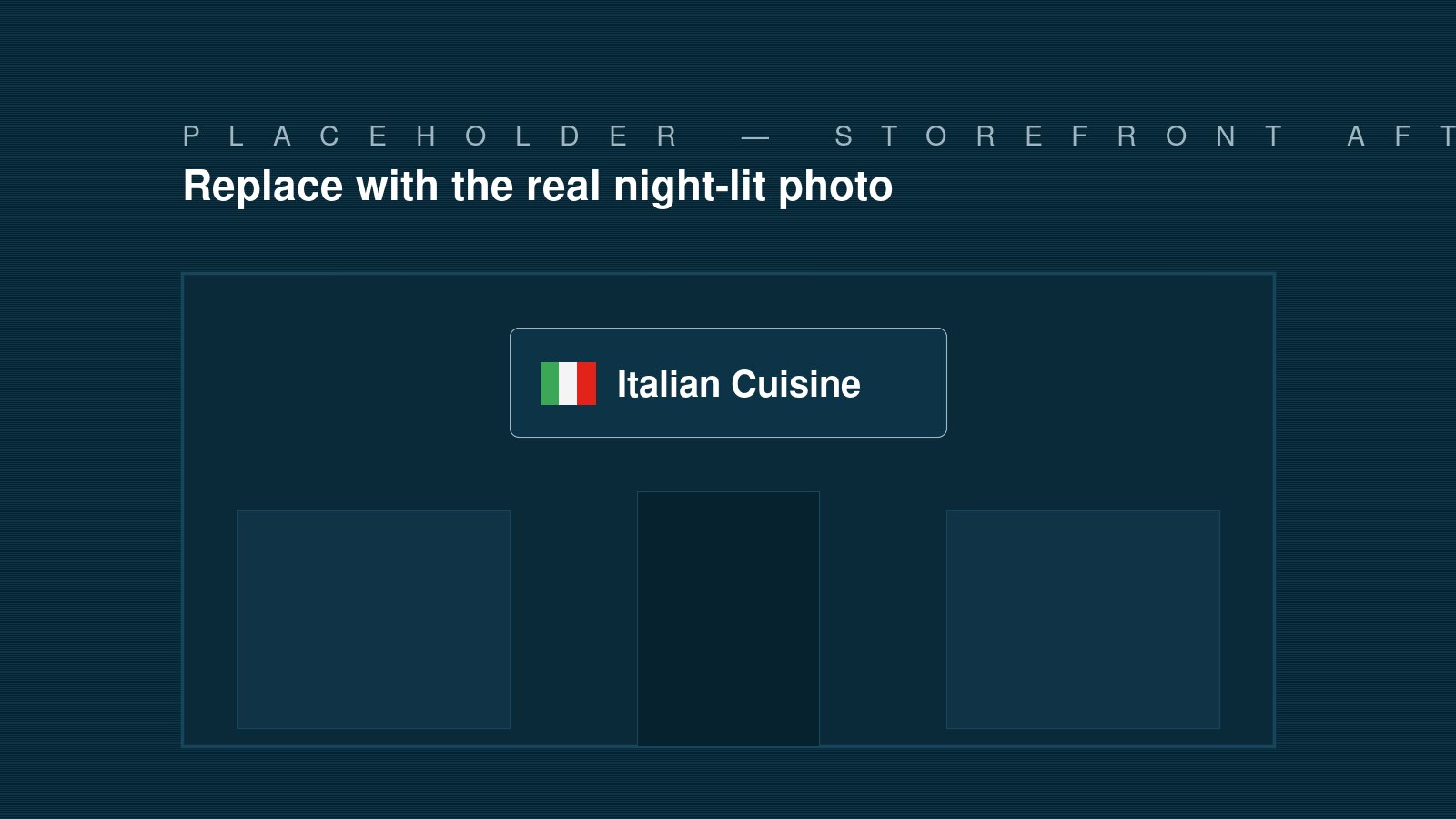
We replaced the flat, muted signage with something vibrant yet classy — on-brand, and built around the single most important message, read at a glance: ‘Italian Cuisine.’ The Italian flag was rendered as a clean line with the wordmark set inside it, and the whole block was illuminated at night.
The result is a storefront that reads as a destination rather than a blank façade, day and night — the brand finally claims its space in the complex and is seen by the foot traffic that used to walk straight past.